Buy the car restraint first. A harness, crate or carrier that an independent lab has crash tested does more for your dog’s safety than any other travel item, and it is the one place where a marketing claim and a real test result can look identical on a product page. If you fly, the next purchase is a soft carrier that fits your airline’s size limit, and rules differ by airline. Everything else (seat covers, bowls, beds, ramps) is comfort and convenience.
As an Amazon Associate we earn from qualifying purchases.
Below: what Center for Pet Safety (CPS) certification means, which harnesses, crates and carriers are on its current list, how to pick by dog weight, cabin rules for five US airlines, and a short packing checklist. Each product named here is also on our wishlist.
What to buy first: car restraint, then everything else
Work through this order:
- A car restraint that matches your dog’s weight and your car (harness, crate or carrier).
- If you fly: a cabin carrier that fits your airline’s limit, or a hard crate if you are going abroad.
- Water, a bowl and a bed or mat for the stops and the hotel.
- Seat covers and cargo liners, if you want a cleaner car.
- Identification, and a GPS tracker if your dog is a bolter.
What does “crash tested” or “CPS certified” mean for a dog harness, crate or carrier?
CPS is a research and advocacy nonprofit that crash tests pet restraints. A CPS certification means the manufacturer made a voluntary commitment: to meet safety standards CPS developed independently, to monitor quality control, and to be truthful in its marketing. The harness test follows a CPS protocol (CPS-001-014.01).
Two details are easy to miss. First, every CPS product page lists a “test dog weight”, the weight of the dummy dog used in the test. That is not always a maximum rating for the product, so read the page, not just the box. Second, “crash tested” on a product page can mean the maker tested it in-house. Only a result on a CPS page tells you an independent lab did the test.
CPS also lists tests by year. A harness tested in 2014 is not the same as one tested in 2024, so check the date on the CPS page too.
Which dog car harnesses have an independent crash-test certification?
At the time of writing, three harnesses are on the CPS certified list (22 products across its first two pages; the list page is inconsistent, so it may be incomplete):
- Sleepypod Clickit Range 8.3Our pick: sizes S to XL, 110 lb (50 kg) test dog, tested November 2024, 5 Star.
- Sleepypod Clickit Sport 9.7Our pick: CPS ratings are Small to 25 lb (11 kg), Medium 45 to 90 lb (20 to 41 kg), Large 75 to 90 lb (34 to 41 kg) and XL to 90 lb (41 kg), tested July 2014, 5 Star. The ranges overlap because CPS says the Medium, Large and XL are built from the same materials, so a dog up to 90 lb in a Medium or Large gets the same protection as in the XL.
- Saker Bomber Harness 8.3Our pick: sizes XS to L, 75 lb (34 kg) test dog, tested November 2022, 5 Star.
No Ruffwear, Kurgo or Gunner harness appears on the CPS list, so a pick like the Kurgo Impact 8.4Our pick is a comfortable harness with no independent crash result we can point to. That does not prove it fails. It means nobody independent has said it passes.
Search for “best dog car harness” and “dog seat belt” and you will find dozens of products with “crash tested” in the title. Open the CPS list and check the name against it.

Do crash-tested crates and carriers protect small dogs better than a harness?
We cannot say which protects better, because CPS tests each product on its own and does not rank restraint types. What we can say is what the list offers by size.
Small and toy dogs. The CPS harnesses on the list start at a Small size rated to 25 lb (11 kg) (Clickit Sport) or XS (Saker Bomber). For very small dogs, the CPS carriers and carrier-beds below are the tested option:
- Sleepypod Mobile Pet Bed 8.3Our pick: 15 lb (7 kg) test dog, tested August 2024, 5 Star.
- PawsInCar Expandable Pet Carrier 8.4Our pick: 12 lb (5.4 kg) test dog, tested January 2026, 5 Star.
- Away Pet Carrier 8.8Our pick: 18 lb (8 kg) test dog, tested May 2026, one size.
- Sleepypod Mobile Pet Bed Mini 8.3Our pick: tested with a 7 lb (3 kg) dog, August 2024, 5 Star.
- Sleepypod Atom 8.3Our pick: tested with a 12 lb (5.4 kg) dog, August 2024, 5 Star.
- Sleepypod Air 8.3Our pick: tested with an 18 lb (8 kg) dog, January 2025, 4 Star, the one lower CPS result in this group.
- PawsInCar Vegan Leather Pet Carrier 8.4Our pick: tested with a 15 lb (7 kg) dog, October 2023, 5 Star. The maker advises it for dogs under 10 lb (4.5 kg).
- PawsInCar Ultimate Car Travel Pet Carrier 8.0Our pick: tested with a 25 lb (11 kg) dog, September 2024, 5 Star.
Large dogs. On the crate side, Gunner G1 Kennel 9.2Our pick has CPS 5 Star results for Small (30 lb, 14 kg test dog), Medium (45 lb, 20 kg) and Intermediate (75 lb, 34 kg), each “with Strength Rated Anchor Straps”. The straps are part of the result, so a crate tied down with ordinary straps is not the tested setup. There is no CPS entry for a Gunner G1 Large. Other CPS-listed crates, all 5 Star:
- Cabela’s GunDog Kennel 8.3Our pick: Large tested with a 90 lb (41 kg) dog (May 2024), Intermediate with a 75 lb (34 kg) dog (November 2022).
- Lucky Duck Lucky Kennel 8.3Our pick: Large tested with a 110 lb (50 kg) dog (July 2022), Intermediate with 75 lb (34 kg) (July 2022), Medium with 50 lb (23 kg) (January 2024).
- Rock Creek Aluminum Kennel, Medium 8.3Our pick: tested with a 50 lb (23 kg) dog, December 2020. Medium size only.
Diggs Passenger Carrier is not on the current CPS list, so we do not call it crash tested.
Harness, crate, carrier or booster: how to choose by dog weight and car
| Product | Type | Independent test | CPS test dog weight | Notes |
|---|---|---|---|---|
| Sleepypod Clickit Range | Harness | CPS, 5 Star, Nov 2024 | 110 lb (50 kg) | Sizes S to XL |
| Sleepypod Clickit Sport | Harness | CPS, 5 Star, Jul 2014 | Small to 25 lb (11 kg); Medium 45-90 lb (20-41 kg) | Older test; sizes S to XL |
| Saker Bomber Harness | Harness | CPS, 5 Star, Nov 2022 | 75 lb (34 kg) | Sizes XS to L |
| Gunner G1 Kennel (S, M, Intermediate) | Crate | CPS, 5 Star, 2015 to 2017 | 30, 45, 75 lb (14, 20, 34 kg) | Tested with strength rated anchor straps; no Large entry |
| Sleepypod Mobile Pet Bed | Carrier-bed | CPS, 5 Star, Aug 2024 | 15 lb (7 kg) | Mini: 7 lb (3 kg) test dog |
| Sleepypod Atom | Carrier-bed | CPS, 5 Star, Aug 2024 | 12 lb (5.4 kg) | One size |
| PawsInCar Ultimate Car Travel Pet Carrier | Carrier | CPS, 5 Star, Sep 2024 | 25 lb (11 kg) | One size |
| PawsInCar Expandable Pet Carrier | Carrier | CPS, 5 Star, Jan 2026 | 12 lb (5.4 kg) | For small dogs |
| Cabela’s, Lucky Duck, Rock Creek crates | Crate | CPS, 5 Star, 2020 to 2024 | 50-110 lb (23-50 kg) by size | See crate list above |
| Away Pet Carrier | Carrier | CPS listed, May 2026 | 18 lb (8 kg) | One size |
| Kurgo Impact | Harness | No independent test found | None | Not on the CPS list |
The rule for this table: “CPS” appears only where a CPS page says so. Otherwise it says no independent test found.
How to choose:
- Under about 15 lb (7 kg): a CPS-listed carrier or carrier-bed, belted into the back seat.
- Mid-size dogs: a CPS-listed harness in the right size, or a crate if your car has room for one.
- Large dogs: a harness rated for your dog’s weight, or a CPS-listed large crate in the cargo area, strapped down as tested.
- Match the weight on the CPS page to your dog, and buy the size CPS tested. A different size is a different product.
Prices vary, and each wishlist card shows the current level. Crates sit at the top of the cost range, carriers and harnesses are lower.
Who should skip which gear
- Skip the crate if your dog is small and rides on the back seat in a certified carrier. It is another thing to haul.
- Skip the harness if your dog rides in a crate in the cargo area, as long as the crate is tied down the way the maker says.
- Skip a “crash tested” label you cannot find on the CPS list. Use the product for comfort, and do not count on it in a crash.
Seat belt tethers and uncertified harnesses: what they do and do not do
A seat belt tether clips a harness to the car’s belt system. It keeps a dog from roaming and from jumping into the front. Whether the whole setup holds in a crash depends on the harness, the tether, and the hardware, and no independent result exists for most combinations. Treat an uncertified harness plus tether as restraint for everyday driving, not as a promise of crash protection.
If you already own one, nothing stops you using it. The CPS-listed harnesses above are the pick if crash performance is the point.
Back seat covers, hammocks and cargo liners for keeping the car clean
None of these is a safety product. A hammock or seat cover holds mud, water and hair off the upholstery, and a cargo liner does the same for the boot. Pair them with a restraint from the sections above, not instead of one.
- Hammock-style back seat cover: Kurgo Wander Hammock 7.7Our pick, Meadowlark 8.2Our pick, 4Knines 9.2Our pick, iBuddy 8.3Our pick.
- Cargo liner: K9 Ballistics 8.0Our pick, Kurgo Rover 7.9Our pick.
- Car bed: Ruffwear Dirtbag 8.6Our pick.
Check that any cover leaves the seat belt buckles reachable, so a harness can still click in.
Flying with a small dog: cabin carrier rules by airline
The answer for flying: a soft-sided carrier about 17-18 in (43-46 cm) long, 11 in (28 cm) wide and 9-11 in (24-28 cm) tall fits the under-seat rule of most major US airlines. It must fit your airline and your aircraft, so check with the airline before you buy.
| Airline | Soft-sided carrier | Hard-sided carrier | Fee at time of writing |
|---|---|---|---|
| Delta pet policy | 18 x 11 x 11 in (46 x 28 x 28 cm), recommended; actual max varies by aircraft | Check with the airline | $150 US, Canada, Puerto Rico, USVI; $200 international |
| United pet policy | 11 x 18 x 11 in (27 x 45 x 27 cm) | 9 x 17.5 x 12 in (22 x 44 x 30 cm) | $150 each way |
| American pet policy | 18 x 11 x 11 in (46 x 28 x 28 cm) | 19 x 13 x 9 in on mainline; American Eagle smaller, check with the airline | $150 per kennel, each way |
| Alaska pet policy | No larger than 17 x 11 x 9.5 in (43 x 28 x 24 cm) | Check with the airline | $100 per carrier; $35 wholly within Hawaii |
| JetBlue pet policy | Up to 17 x 12.5 x 8.5 in (43.2 x 31.8 x 21.6 cm), soft or hard, leak-proof | Same size limit as soft | Check with the airline |
| Southwest pet policy | Must fit under the seat; dimensions: check with the airline | Check with the airline | $125 per carrier, one way (mainland) |
Rules change, so open the airline’s page before you book. Other things the pages say:
- Delta: one pet per kennel, the pet stays in the kennel at all times, minimum age 8 weeks for domestic flights, no pets in Business, Delta One or Premium cabins, and cabin slots are capped. The page recommends booking by phone. No weight limit is stated, but the pet must be able to move comfortably without touching the sides.
- United: cats and dogs only in the cabin. Up to 2 pets per person if you buy a second seat. On A319, A320, A321neo, 737-800/MAX 8, 737-900/MAX 9 and 757-300 aircraft, one pet. The checked-pet program has ended. No weight limit is stated.
- American: the carrier counts as your carry-on, plus one other item. Soft carriers need padding, water-repellent material and mesh ventilation on 3 or more sides.
- Alaska: no cabin weight limit stated, aimed at small dogs.
- JetBlue: up to two pets per traveler, each in their own carrier. The pet and carrier count as your personal item. The page says no large dogs.
- Southwest: one carrier per ticketed passenger, up to two small pets of the same species. The carrier counts as a carry-on or personal item. Booking is by phone.
For under-seat picks to look at, there are a few on the wishlist: Sleepypod Mobile Pet Bed 8.3Our pick, Away Pet Carrier 8.8Our pick, Sherpa Original Deluxe 8.2Our pick. Compare their listed dimensions against the row for your airline. If your dog is too big for the cabin, the next section is for you.
CPS crash tests cover car use. Whether an airline accepts a given carrier is each airline’s decision, so a CPS result and an airline “yes” are two separate checks.
Flying with a big dog or going abroad: hard crates, health certificates, USDA APHIS
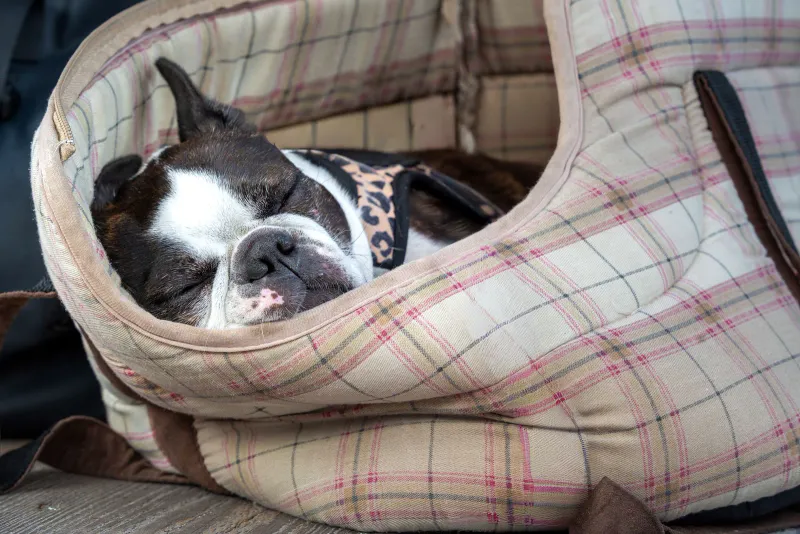
Cabin space is for small dogs. For a bigger dog, check what the airline offers, because options have narrowed. United’s checked-pet program has ended, and the airline says cargo is only for certain active-duty military and State Department travelers. American takes checked pets only for active-duty US military and State Department travelers on orders ($200 per kennel); other owners go through American’s PetEmbark cargo service. If you need a hard crate for a flight, Petmate Sky Kennel 7.6Our pick is on the wishlist. Ask the airline whether it accepts a specific crate before you buy.
Health certificates. The USDA’s Animal and Plant Health Inspection Service (APHIS) describes a USDA-endorsed pet health certificate for international travel. You get it through a USDA-accredited vet who knows the destination’s entry rules. United requires a health and vaccination certificate for all international flights, including Canada and Mexico. Rules for flights inside the US differ by airline and state, so ask the airline and your vet.
Coming home. A dog vaccinated in the US that was recently in a country the CDC treats as high risk for dog rabies needs a “Certification of U.S.-Issued Rabies Vaccination” form. An accredited vet submits it before you leave the US. The CDC’s dog import rules (page dated 1 August 2024) depend on whether the dog spent the last 6 months in a high-risk country and where it was vaccinated. Unvaccinated dogs from high-risk countries are not allowed in. For the details, CDC-INFO is 800-232-4636.
Start the paperwork early. Vets need time to complete forms and entry rules are set by each country.
Heat, water and rest stops on a road trip
Never leave a dog in a parked car. Many states have laws about animals left in parked vehicles, so check yours. A few states, as of 2019 California, Connecticut, Maine, Massachusetts, New Hampshire and Rhode Island, expressly prohibit dogs riding unrestrained in open pickup truck beds (Animal Legal & Historical Center, Michigan State University). Few states have a specific law about dogs riding loose inside the car; check your state.
Practical points that need no data:
- Plan a stop every couple of hours so the dog can drink, pee and stretch, on a leash.
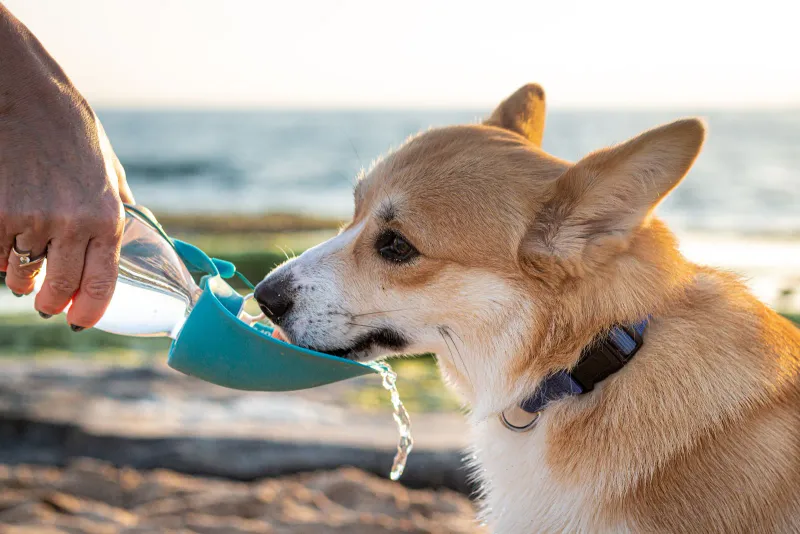
- Carry water from home, and offer it at each stop. A collapsible travel bowl keeps it easy. Kurgo Zippy Bowl 7.6Our pick, Ruffwear Cinch Top 8.2Our pick and Prima Pets silicone 8.2Our pick are on the wishlist.
- A cooling vest can help on warm days. Ruffwear Swamp Cooler Harness 8.2Our pick and Canada Pooch Cooling 2.0 7.9Our pick are on the wishlist. Ask your vet whether your dog’s breed and age need extra care in the heat.
Motion sickness, ID and microchip, and what to ask your vet
If your dog gets restless, drools or vomits in the car, tell your vet before the trip. Ask about motion sickness, anxiety and anything you can give. We do not give dosing advice, and we cannot say what suits your dog.
Questions worth taking to the appointment:
- Is my dog fit for the trip, the flight or the temperatures at the destination?
- Are vaccinations current for where we are going?
- If I am leaving the US or coming back, what paperwork does the destination or the CDC need, and how long does it take?
For identification, put a tag with your mobile number on the collar, and check that your microchip details are current. A GPS tracker adds a layer if your dog bolts: Tractive Dog 6 9.6Our pick and Fi Series 3+ 8.2Our pick are on the wishlist.
Travel bowls, beds, ramps and extras worth packing
- Bowl: collapsible bowls pack flat. Mud River Oasis 8.2Our pick and Mountainsmith K-9 Backbowl 8.2Our pick are two more options.
- Bed or cot: K&H Original Pet Cot 8.7Our pick for hotels and camps; Coolaroo 7.5Our pick and PawHut cooling cot with UV canopy 8.2Our pick if you are outdoors a lot.
- Crate mat: Big Barker 9.1Our pick and MidWest QuietTime 8.2Our pick for a familiar surface in a new place.
- Ramp or steps: PetSafe Happy Ride 8.2Our pick and EveryYay 9.1Our pick help dogs get into tall cars without a jump.
- Backpack carrier: K9 Sport Sack Plus 2 8.0Our pick for a small dog on foot, optional.
- Life jacket: Kurgo Surf n Turf 8.4Our pick if you will be near water.
- First-aid kit: see our first-aid kit page on the wishlist.
Dog travel checklist (short)
Before you leave:
- Restraint fits and is the size CPS tested (or the size you decided on)
- Vet visit done; vaccination records and any health certificate in a folder
- Airline page read, carrier measured, booking confirmed by phone if the airline asks
- Collar tag with your mobile number; microchip details current
In the car or bag:
- Leash, water, collapsible bowl, bags
- Bed or mat from home
- Spare collar or leash
- Towel for mud
- Any meds your vet has prescribed
FAQ
Is a crash-tested harness safe for my dog in any car? A CPS result applies to the product tested, at the test dog weight, on the CPS test setup. It is not a guarantee in every crash. Use it as the best independent signal available, and follow the maker’s fitting instructions.
Is there a crash-tested harness for a toy dog? The harnesses on the CPS list start at a Small size rated to 25 lb (11 kg) (Clickit Sport) or XS (Saker Bomber). For toy dogs, a CPS-listed carrier is the tested option.
Does a CPS result mean an airline will accept the carrier? No. CPS tests car crashes. Each airline sets its own cabin carrier rules.
Is there a weight limit for dogs in the cabin? The Delta, United, Alaska and Southwest pages state no weight limit. The dog must fit in the carrier and, on Delta, move without touching the sides. JetBlue’s page says no large dogs. Ask your airline.
Do I need a health certificate to fly? For international flights, yes: APHIS describes a USDA-endorsed health certificate via an accredited vet, and United requires a certificate even for Canada and Mexico. For US domestic flights, rules vary by airline and state, so ask.
What if I find a different list of certified products? Check the date. CPS updates its list, and pages that look current may carry results from several years ago. If you spot an error on this page, write to us.
Sources
- Center for Pet Safety, “CPS Certified Products”, accessed November 2026. centerforpetsafety.org/cps-certified and page 2
- Center for Pet Safety, “Sleepypod Clickit Range”, accessed November 2026. centerforpetsafety.org/sleepypod-clickit-range
- Center for Pet Safety, “Sleepypod Clickit Sport”, accessed November 2026. centerforpetsafety.org/cps-certified/sleepypod-clickit-sport
- Center for Pet Safety, “Saker Bomber Harness”, accessed November 2026. centerforpetsafety.org/saker-bomber-harness
- Center for Pet Safety, “Gunner G1 Kennel” (Small, Medium, Intermediate), accessed November 2026. Small, Medium, Intermediate
- Center for Pet Safety, “Sleepypod Mobile Pet Bed”, accessed November 2026. centerforpetsafety.org/sleepypod-mobile-pet-bed; Mini
- Center for Pet Safety, “PawsInCar Expandable Pet Carrier”, accessed November 2026. centerforpetsafety.org/pawsincar-expandable-pet-carrier
- Center for Pet Safety, “Away Pet Carrier”, accessed November 2026. centerforpetsafety.org/away-pet-carrier
- Delta Air Lines, “Pet Travel Overview”, accessed November 2026. delta.com/us/en/pet-travel/overview
- United Airlines, “Traveling with pets”, accessed November 2026. united.com
- American Airlines, “Pets”, accessed November 2026. aa.com
- Alaska Airlines, “Pets” and “What to know before traveling with a canine companion”, accessed November 2026. alaskaair.com/content/travel-info/pets, news.alaskaair.com
- JetBlue, “Traveling with pets”, accessed November 2026. jetblue.com/help/traveling-with-pets
- Southwest Airlines, “Pet policy”, accessed November 2026. support.southwest.com
- USDA APHIS, “Pet travel”, accessed November 2026. aphis.usda.gov/pet-travel
- CDC, “Dog importation”, page dated 1 August 2024, accessed November 2026. cdc.gov/importation/dogs
- Animal Legal & Historical Center, Michigan State University, “FAQ: Dogs transported in pickup truck beds”, accessed November 2026. animallaw.info